

Google, Bing and Other Search Engines, Their Accuracy, and How to Find Accurate Search Results
By refining your search queries, you will be able to improve the results that you receive from Google and other search engines. However, Google has some clever ways to chop down and remove content that other search engines ignore or leave out. My last point might surprise many being a lover of many things Google as I still feel the search engine has been over-optimised for. Given March 2024 Helpful Content Update, I remain unconvinced with impartial search results from the Alphabet corporation and Microsoft.
Here are a few tricks and I end with various mindsets that are now needed if you wish to find out what the real narrative is.
Use Boolean Operators to Improve Search Results
The search results mention that using Boolean operators like quotation marks (“keyword phrase”) can help narrow down search results and force Google to include the exact phrase. This was more effective in the past, but still has some utility now.
If you are serious about search, this guide ‘how to hack Google’ is very insightful: https://www.studocu.com/row/document/tribhuvan-vishwavidalaya/computer-network/google-hacking-guide/8206685. I used to use this to find out information when the World Wide Web was very young and backdoors and exploits were easy pickings.
Eliminate Certain Domains from Search Results
You can use the “-site:domain.com” operator to exclude specific websites or domains from your search results. This can help filter out low-quality or irrelevant sites. Good-bye Trip Advisor and a host of travel types when you are looking for private accommodation and real-life local stories.
Focus on Long-Tail, Specific Queries and Refine Them
Google’s algorithm struggles with any form of complex query based on something broad – for example cookery. Focusing on specific, long-tail queries rather than broad, generic ones can yield better results. This is best done with ‘people also ask’, which I come to now.
Use “People Also Ask” to Guide Queries
Search results suggest looking at the “People Also Ask” section of Google’s results and utilizing those related queries to refine and expand your own search. Search these rich snippet results to see if you can finally generate something that works for you. I recommend aiming for the ones without a trite, or has a closed answer like – ‘yes, you can’.
Make use of Search Modifiers, but be Careful
Using modifiers like “how to”, “best”, “review”, etc, can help tailor a search to find more actionable, informative content rather than just general information. There are lists – top 5 or top 10 things but too many of these terms have a tendency to be heavily optimised and if you’re having issues finding things.
Over the past 10 – 15 years these articles have flooded the internet with out-of-date and irrelevant information. If you see when the article was written, and if it was written pre-pandemic in the realm of travel and hospitality, I would not recommend a click through.
Indeed, many AI written articles flood search engines with very thin search results – hence the various ‘Helpful Content Updates’.
Try Alternative Search Engines For More Truthful Results
While not mentioned in 99.99% of search results or blogs by SEOers, using alternative search engines like Searx, https://copp.gg aggregates results from multiple sources. These may provide a different perspective and more diverse results than Google.
Another is ECOSIA https://www.ecosia.org It is one of the best search engines that respects privacy.
BING https://www.bing.com offers probably the same level of ‘reliable for Google’ results as Google does.
Afterthoughts on Search Reliability and an Experiment You Can Try Yourself
If you’re into research especially about ‘high conflict’ areas of the world try https://www.lycos.com.
The results that return do make you wonder about the impartiality of Google and, if like China, (with Google’s Operation Dragonfly) there is actually information filtering in the ‘free western world‘).
Bing search engine is available in China and its search results are being censored following Chinese government guidelines.
The key is to experiment with different query refinement techniques and see what works best for your specific information needs.
Relying solely on Google’s algorithm is no longer sufficient for many users including myself as I follow many investigative journalists.
Changing a question to a negative sometimes elicits a different response.
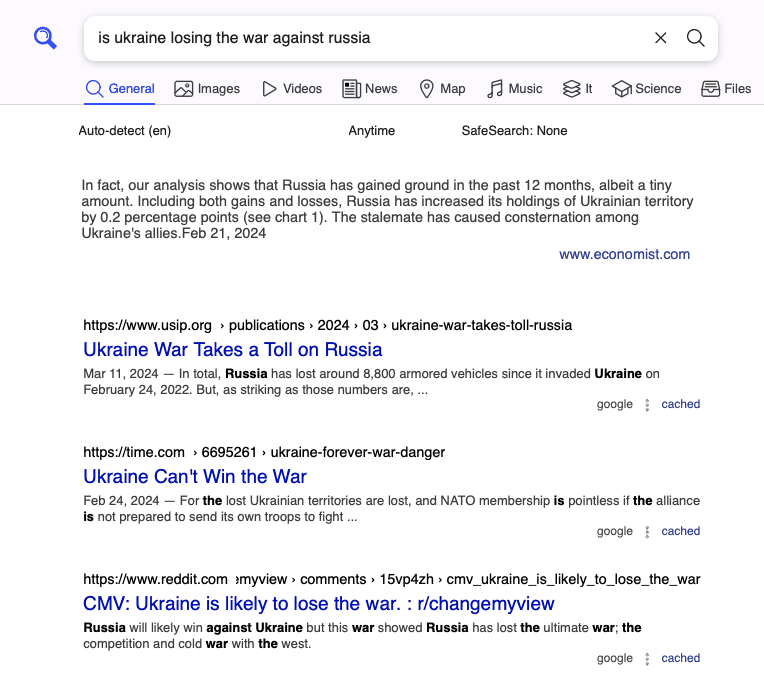
Here is a real life example if you wish to test the accuracy of search engines and if there are filters in place for political and propaganda ends – which is very worrying if you were looking for something called updated ‘helpful content’ 😀 and how selective the answers are from the same source when it comes to snippets.
Is Ukraine winning the war against Russia
Is Ukraine losing the war against Russia
Searx, Bing and Google on the second question – both Google and Searx quoting the same source.



- AI in SEO: Maximising Your Online Visibility - 21 October 2025
- Effective SEO Reindexing Techniques: A Guide - 21 October 2025
- Local SEO Course Passed - 2 February 2025