
How To Use ChatGPT for SEO Content Creation: A Comprehensive Guide
ChatGPT, is a large language model (LLM) application with the potential to significantly enhance your SEO efforts. The world of SEO is a dynamic one, constantly evolving alongside user behaviour, search engine algorithms, and more AI generated online content. To stay afloat in this competitive sea, SEOs must be adaptable and resourceful and learn how to scale content effectively while retaining uniqueness, relevance and fitting the client profile.
I have to say ChatGPT isn’t a magic bullet for SEO success. Right now it can be a powerful brainstorming partner, aiding you in various aspects of your strategy and speeding up workflow. This article will delve into the world of ChatGPT, exploring how it can be used to generate keyword ideas, create content outlines, and even identify potential backlink opportunities.
We’ll also discuss the limitations of ChatGPT and provide best practices to ensure you’re using it effectively within your SEO workflow. By understanding both the strengths and weaknesses of this innovative tool, you can leverage its power to optimize your content and climb the search engine rankings ladder.
Keyword Brainstorming with ChatGPT: A Stream of Inspiration
The foundation of any SEO strategy lies in keyword research. Identifying the right keywords allows you to tailor your content to what users are actively searching for. Here’s where ChatGPT shines and saves a lot of time using say, Answer the Public. You can leverage it to generate a plethora of keyword ideas, including:
- Long-Tail Keywords: These highly specific keywords with lower search volume can attract targeted traffic with high conversion potential.
- Latent Semantic Indexing (LSI) Keywords: These semantically related keywords help search engines understand the true context of your content, improving your ranking for relevant searches.
- Related Keywords: Broaden your scope by discovering keywords that complement your core topic.
Or doing all three
Prompting ChatGPT for Keyword Ideas:
Here’s an example prompt to get you started:
“Provide me with a list of long-tail keywords and LSI keywords related to ‘barf dog food””
CHATGPT 3.5
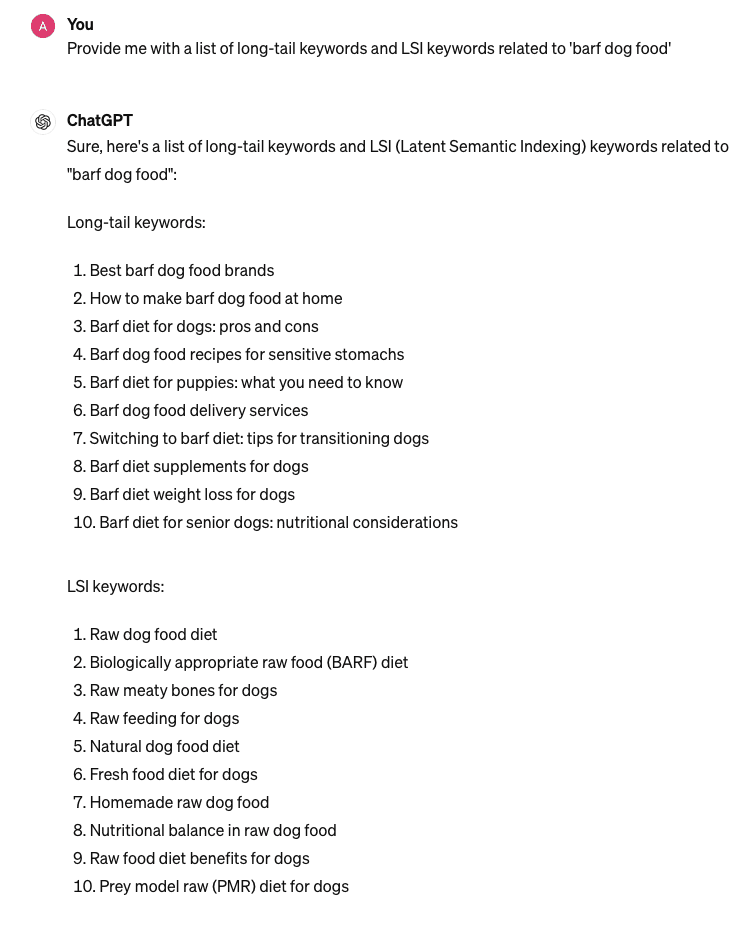
ChatGPT will generate a list of keywords that can spark further research and content creation. Throwing them through Adwords bought up some interesting results – especially for LSI keywords.

Throwing these into Adwords Suggest bought up more than 2,400 keywords.
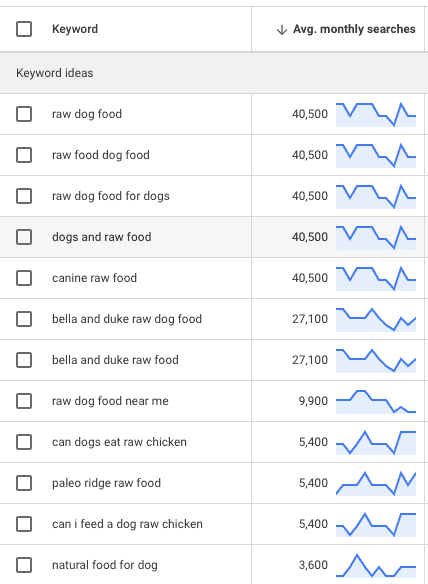
Remember: While this method is fast, it doesn’t replace the need for in-depth keyword research using dedicated SEO tools like Semrush’s Keyword Magic Tool. These tools provide crucial data like search volume, competition level, and keyword difficulty, enabling you to prioritise high-value keywords.
Careful with ChatGPT’s Limitations
It’s important to be aware of ChatGPT’s limitations when it comes to keyword research. Here are some key points to consider:
- Inaccurate Search Volume Data: ChatGPT cannot access real-time search volume data but it can easily cross reference data. Some keywords suggested might have minimal search volume or be entirely irrelevant. However, using Google Adwords from a great handful of 10 initial keywords bought up 2,400 other keywords.
- ChatGPT4 cut off. The most recent ChatGPT will go up against the brick wall as its knowledge cuts off from April 2023. This means, any trending or recent topic may be affected by the results.
Best Practices for Effective Keyword Brainstorming with ChatGPT
To maximize the effectiveness of ChatGPT for keyword research, follow these best practices:
- Verification is Key: Always double-check ChatGPT’s suggestions with a dedicated SEO tool to verify search volume and, very important competition level.
- Prioritise Intent: Don’t just chase high-volume keywords. Focus on keywords that align with user search intent. Analyse the intent behind each keyword to ensure your content addresses the user’s specific needs and ChatGPT does that very easily.
USING CHAT GPT FOR SEO AND WRITING
FOR SEARCH INTENT
ChatGPT does the same job as SEMrush with search intent for “Commercial”, “Navigational”, “Transactional”, or “Informational” keywords. I’d say actually its nicer and you can get information out very quickly if you need to answer a quick question from the content team about user intent and focus.
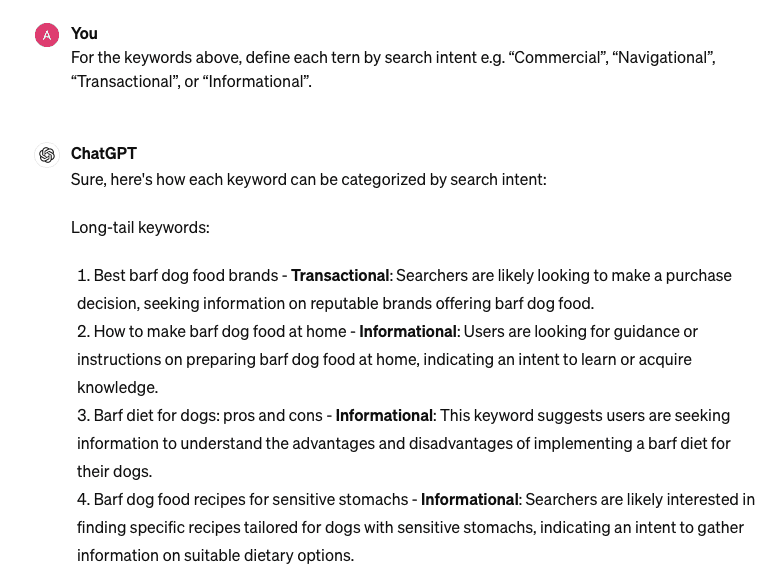
Using ChatGPT for sourcing keywords at the top and bottom of the sales funnel
It gets more interesting, you can ask ChatGPT to arrange the keywords from top to bottom of the sales funnel stating, the search intent type and if there’s any reliances of the keywords to each other in the stage to progress to the next one.
The results are very impressive.
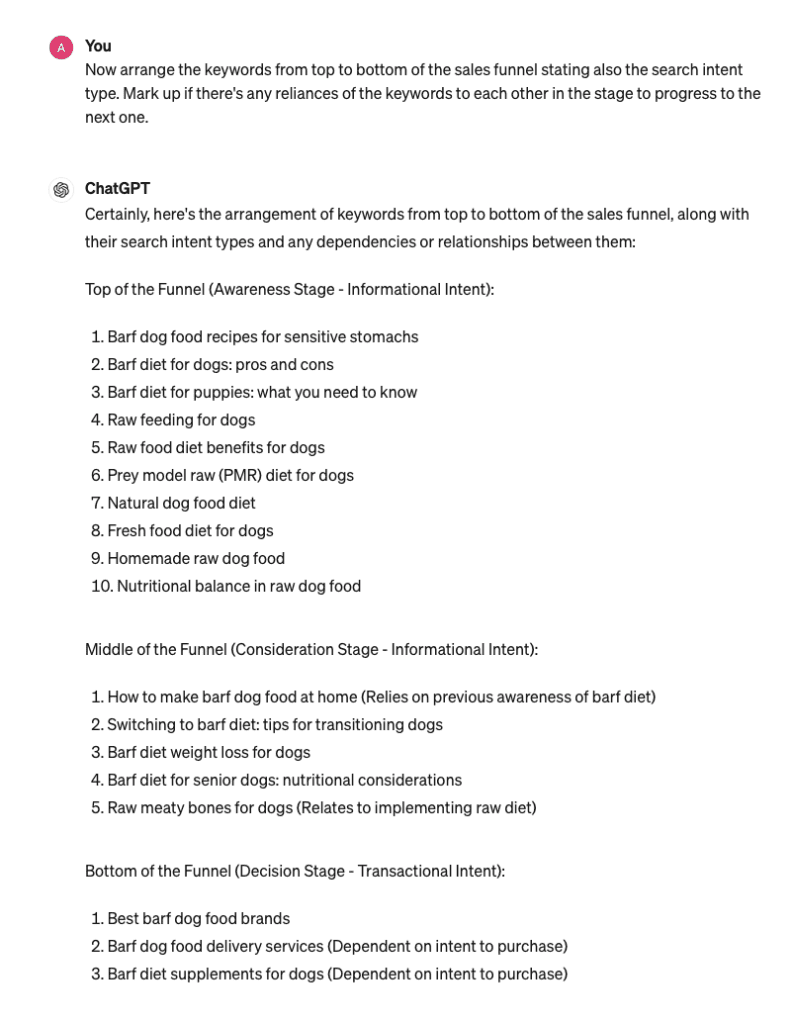
How To Insert Keyword Volumes To Suggested in ChatGPT With Top and Bottom Of The Funnel Suggested Words
You can then mix up all the data from keyword research down to your planned content with a prompt. “With keyword volume data as a number, create for each stage and keyword and idea of total search volume per keyword.

Now the results are pretty impressive, seeing as the whole process right now would have used a lot of clicks in SEMrush – plus paying for that information, and all we have used is ChatGPT and Google Adwords for zero cost.
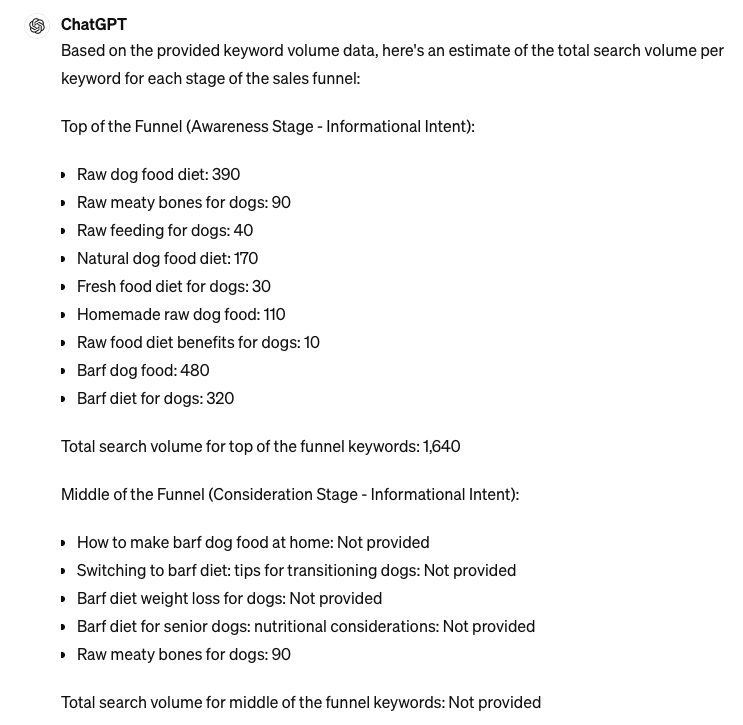
How To Use ChatGPT for Keyword Clusters,
Search Volume and Search Intent
This is where ChatGPT comes into a world of its own. You can ask it to create keyword clusters for keywords, search volume, and buyer intent, per cluster.
Care has to be taken how it adds up each cluster.

Unveiling ChatGPT’s Potential Beyond Keywords. Using it for Article Ideas
While the primary focus of this article has been keyword research, ChatGPT’s capabilities extend beyond that. Here are some additional ways you can leverage it for SEO:
- Content Ideation: Struggling to come up with compelling content ideas? Sure everyone does. Prompt ChatGPT with your target topic and ask it to generate engaging content outlines or brainstorm potential subtopics. Not only that it can create a full on strategy using the stages we have previously used.
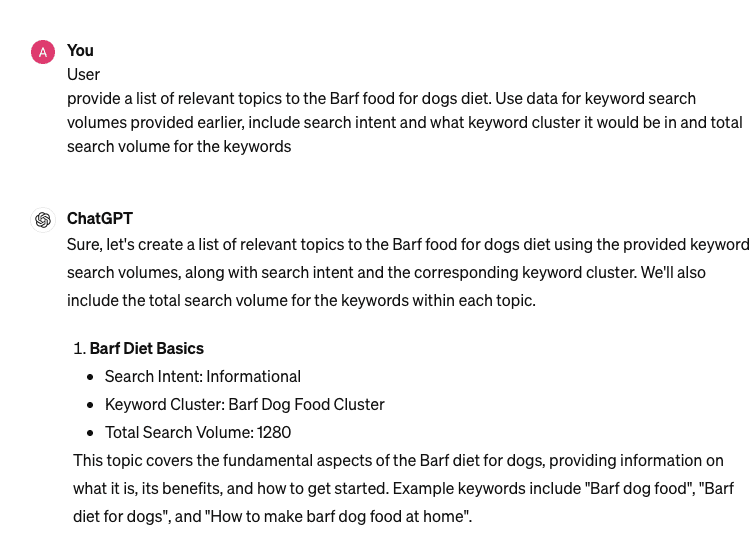
- Using a prompt like: “provide a list of relevant topics to the Barf food for dogs diet. Use data for keyword search volumes provided earlier, include search intent and what keyword cluster it would be in and total search volume for the keywords”, virtually summarises everything that we need and going to need.
- Note that once you start to get focused, it’ll focus on ‘Barf food for dogs diet’ as a main idea for the keyword tone. Thus, be careful with generic subjects and better suggest the actual keyword group / cluster you are aiming for. Here is the prompt and a great example.
From this data you can start to create a blog writing strategy and even creating certain conditions for each stage of the buying process and client’s intent. You may ask for it to include keyword search volumes, user intent, keyword clusters, and even LSI flow between the articles.
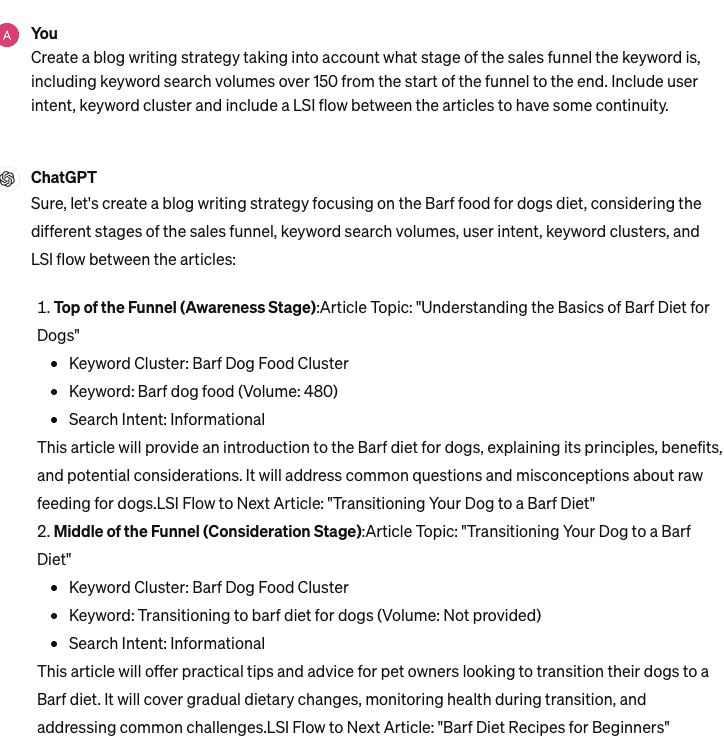
Using ChatGPT For Creating SEO Content Briefs & Outlines
From the previous section we have already gained a lot of information to make informed decisions about article creation plus what order to write things, the logical flow and its purpose.
I used the prompt “Generate a Content Outline and Brief for Understanding the Basics of Barf Diet for Dogs“. As we can see from the previous result we got information on “Barf diet for dogs, explaining its principles, benefits, and potential considerations. It will address common questions and misconceptions about raw feeding for dogs”.

We see from the article above, it has actually included all the salient points, namely its “principles, benefits and misconceptions”.
As you have followed the prompts, if you scroll down you will find that ChatGPT has already stated its Objective, Audience, Tone, Keywords, Length and gone beyond that to label Sources and even a Call to Action.
But let’s say you didn’t use that prompt which I used. Unlocking ChatGPT’s full potential for SEO hinges on one key factor: the quality of your prompts.
Providing ChatGPT with clear and specific instructions leads to more effective outputs, especially when crafting content outlines. I have shown you some of my tricks with a process and workflow. However, if anything within the results is not to your liking even though it has already done its job well, you can elevate and add extra prompts for ChatGPT to conquer the final content briefing.
- Specificity is Key: The more specific your prompt, the better the results. Instead of a generic request like “Give me content ideas,” try something like: “Generate a content outline and brief for a 1500-word blog post on ‘Barf Food for small dog owners, a beginners guide,’ using bullet points and including sections on food preparation, food types, and how much bone to include in the meal.”
- Leverage Formatting: Consider incorporating formatting elements to guide ChatGPT’s output. Utilise bullet points, headings, and subheadings to structure your desired content outline or brainstorm specific sections within a larger project.
- Target Word Count: Specifying a desired word count for your content helps ChatGPT tailor its suggestions. Knowing the intended length allows it to generate a more focused and relevant outline.
- Tone and Style: Don’t forget about the tone and style you envision for your content. ChatGPT can adapt its suggestions based on your input. For instance, if you’re aiming for a casual and conversational blog post, include that in your prompt.
Here’s what I got using a simple prompt of, “Generate a Content Outline and Brief for Understanding the Basics of Barf Diet for Dogs”.
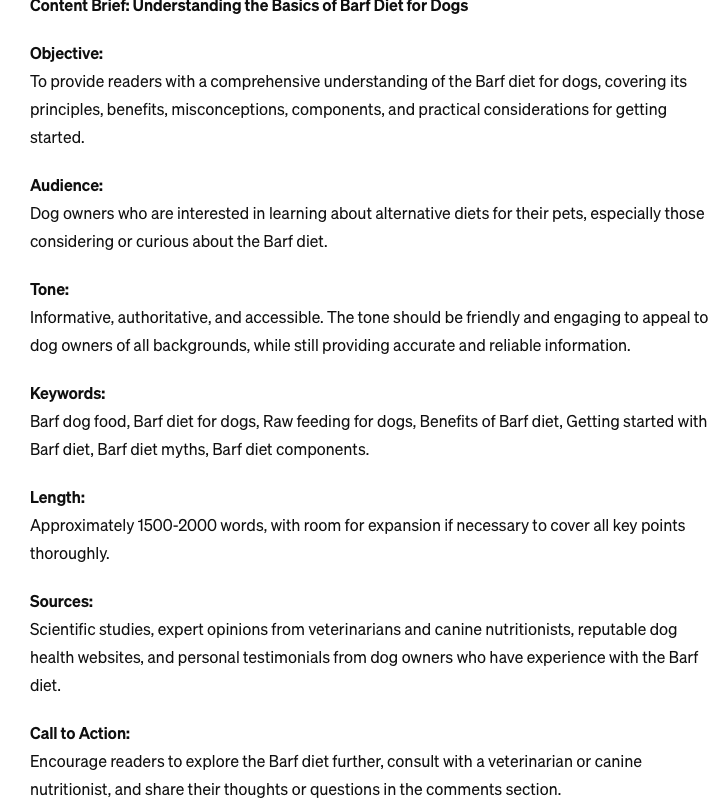
What I did, it all looks good. Let’s get on to, should you let it write stuff for you.
Should You Use ChatGPT To Write SEO friendly Blog Posts & Articles?
In a simple word, “depends” as ChatGPT can churn our content faster than UK water companies dump waste into UK’s rivers. Yes, it’s a machine which can output tonnes of content, fast.
Content IMHO, basically needs a human touch. Search engines now have changed their tune to AI created content. You can just let it rip, but there’s a lot of considerations we’ll get into next.
Good news is, we can see that Google has relaxed its once tough stance on AI content. Now Google doesn’t necessarily penalise AI-generated content, as long as it offers genuine value to users.

Here’s where collaboration shines:
- AI as a Springboard: Utilise ChatGPT to generate a basic draft, like a simple “About Bard Food” section, which you can then tailor to a tone and style, keyword clusters, search volume, where in the funnel, search intent. This kickstarts the process, saving valuable time and testing ideas to see what works. Years ago, this would take 4-5 hours working across platforms and putting work into Excel, using macros, plus spending a lot on SEMrush! So, for the concept, ChatGPT is with you.
Writing an article, ChatGPT and other AI tools are still in their infancy. You need to understand the following.
- Human Editing is Essential: Always review, fact-check, and edit any AI-generated content. Your human expertise ensures accuracy, infuses personality, and elevates the content to resonate with your audience.
Again, with ChatGPT the main issue is with ‘how it writes’. If you ask it to write an SEO based text, you’ll get something which sounds like it’s come from a Star Trek episode. Plastically and just over the top. Here’s the limits with ChatGPT and other AI’s when it comes to article writing.
- The Gist isn’t ‘Everything’ ChatGPT’s content generation hinges on summarising its existing knowledge base and predicting the next word in sequence. This can result in repetitive, formulaic writing that prioritises keywords over originality.
- SEO has no Soul:
- Content optimised solely for search engines often misses the mark. ChatGPT might struggle to create content that adheres to Google’s E-E-A-T guidelines (Experience, Expertise, Authority, and Trust). Truly engaging content necessitates human expertise and insights. Basically, you’ll need an editor in the end, like a chef to see if the omelette dished up actually tastes as good as it looks.
- Accuracy Matters: As discussed above, ChatGPT’s data limitations can lead to factual inaccuracies. Relying solely on its output poses a risk for your website’s credibility. We all heard about that lawyer right using ChatGPT 😀
CHATGPT AND SCHEMA
Adding Schema To Your ChatGPT Written
and Researched Piece of Writing
Schema markup is a powerful tool for SEOs, helping search engines understand your website’s content and structure. One particularly valuable schema application is the FAQPage markup, specifically designed for Frequently Asked Questions sections. These help with titles you have created on page which get shown up in the SERPS. So, when you write the article, consider adding in FAQs as keyword rich, but written for human headings.
Implementing the questions as FAQ schema markup offers a multitude of benefits:
- Rich Results: Schema markup can increase your chances of appearing in Google’s coveted “Featured Snippets” or “People Also Ask” sections. These rich results sections appear directly on the search engine results page (SERP), grabbing user attention and potentially boosting your click-through rate (CTR).
- Enhanced Visibility: By providing search engines with clear context regarding your FAQs, you improve the overall clarity and relevance of your content. This can lead to higher rankings in the SERPs for relevant user queries.
- User Engagement: Rich results with well-structured FAQs allow users to quickly scan and find answers to their immediate questions, directly on the SERP. This enhances the user experience and encourages them to delve deeper into your content.
Now, let’s explore how ChatGPT can supercharge your Article writing and FAQ strategy:
- Identifying Audience Inquiries: Feeling stuck on what questions your audience might have? Simply ask ChatGPT “What are some common questions related to [your topic]?” This will generate a comprehensive list of potential FAQ prompts that directly address your target audience’s needs.
- Crafting Draft Responses: ChatGPT can even assist in drafting initial responses to your identified FAQs. While these drafts might need refinement, they provide a solid foundation to build upon, saving you valuable time and effort.
It’s as simple as giving a prompt in the same chat as we have continued to use. Type in a prompt such as: Give me schema FAQs I can include in Understanding the Basics of Barf Diet for Dogs article. Give me some ideas for headings as well as their answers.
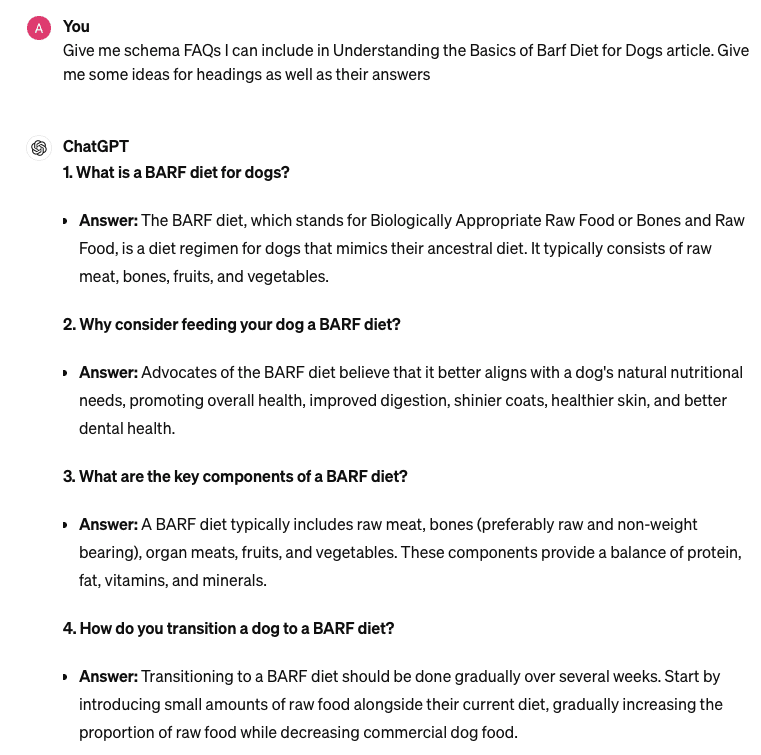
It is best to pad out the answers and definitely fact check them as they have more visibility than, lets say, your article would have outside a 1-3 rank. The answers given, are like a lot of FAQs, after Google’s Helpful Content Updates, a little but on the thin side.
Can You Use ChatGPT for Meta Titles & Descriptions?
Crafting compelling and informative meta titles and descriptions is a crucial piece of SEO – if not the ground roots of SEO, even at SEO director level you can never get away from. These tags are the call to action to your website. However, creating titles and descriptions that are both user-friendly, SEO-optimised and by a less than creative robot machine can be a challenge.
I suggest broadening the LLM, from ChatGPT, and include Gemini, and Perplexity to streamline this process. I’ll look at the strengths and limitations of each LLM, providing tips on crafting effective prompts to generate creative and informative titles and descriptions. We’ll get to look at best practices for optimising your meta content for search engines, ensuring your website stands out in SERPs and attracts organic traffic. For this, I’d say ChatGPT isn’t your only route.
Can ChatGPT Create The Perfect Meta Titles and Description From A Prompt?
I’d argue no. Meta titles and meta descriptions, especially for mobile browsers (at least 50% of your traffic), will have shorter pixel lengths. TBH, using a Mac and Safari, I do not see many un-chopped meta titles or descriptions being more than the maximum amount of pixels for mobile. Sadly no LLM right now has a pixel calculator it can use via prompts while creating a meta description or a meta title. All you can do is try to emulate mobile by making shorter titles and descriptions in the prompt.
Using LLMS Gemini & Perplexity Over ChatGPT Gives You The Edge
While ChatGPT excels at brainstorming, for me Gemini and Perplexity offer a different approach.
These LLMs are specifically designed for factual language and may provide insights into search intent and user behaviour but more, the titles in context to the actual information being researched and presented.
You can leverage them to refine ChatGPT’s suggestions and ensure titles and descriptions are not only catchy but also align with what users are actively searching for.
Example ChatGPT Prompt: “Analyse the following meta title and description: ‘[Title generated by ChatGPT]’. Does it accurately reflect the content and target the right search intent?” This is not only a prompt for the LLM, but one for you, the editor to consider.
The interesting parts with Perplexity and Gemini, it’ll actually give you references for its output. Which is kinda cool if, as an editor, you can quote, “Dog Food Mag 2008 – Barf Won’t Take Off, but it did”. Using this LLM over ChatGPT can give you the edge creatively.
Content Gaps Using LLMS:
ChatGPT, Perplexity & Gemini
I hear content creators raving about how ChatGPT can find content gaps within an article and fill them. However, given that ChatGPT has its cut off date, plus does not reference everything I like to be a little skeptical and take more of a holistic approach with this to make ‘killer SEO’ content.
LLM Strengths and Applications With Locating Content Gaps
- ChatGPT:
- Strengths: Creativity and idea generation.
- Applications: Brainstorm potential subtopics or request a content silo map. Leverage its ability to churn out diverse ideas to explore different angles within your niche.
- Example: Provide the main keyword “vegan baking.” ChatGPT might suggest “Vegan Cookie Recipes,” “Egg Substitutes for Baking,” or “Tips for Decorating Vegan Cakes,” revealing unexplored avenues.
- Limitations: Accuracy and factual verification can be unreliable.
- Perplexity:
- Strengths: Research focus and information retrieval.
- Applications: Analyse competitor content to expose areas they haven’t covered. Explore related searches and user questions to identify knowledge gaps.
- Example: Analyze a competitor’s blog on “hiking trails” with Perplexity. It might reveal they haven’t addressed “vegan backpacking meals” or “hiking gear for beginners on a budget,” uncovering valuable gaps.
- Limitations: Content generation isn’t as robust as ChatGPT.
- Gemini:
- Strengths: Strong reasoning and information structuring.
- Applications: Create a content cluster for your main keyword. Identify subtopics, suggest content formats (articles, videos), and even optimise titles and descriptions.
- Example: Provide “sustainable home gardening” as the main keyword. Gemini might propose a content cluster with articles on beginner gardening tips, composting techniques, and guides to growing specific vegetables organically, offering a well-structured approach.
- Limitations: May not be as adept at generating highly unique or surprising content gap ideas compared to ChatGPT. However, for certain ‘client’ niches this approach is appreciated.
Choosing the Right Tool For Identifying Content Gaps
- Varied Results: ChatGPT excels at brainstorming a wide range of content ideas to explore.
- SEO Focus: Perplexity shines in identifying competitor gaps and user intent for a more SEO-driven approach.
- Structured Planning: Gemini assists in creating well-organized SEO content strategies.
So, is Perplexity the way forward?
The Power of Combining LLM Strengths To Find Content Gaps:
I would urge you to consider this workflow:
- Leverage ChatGPT for initial brainstorming – generate a diverse pool of content ideas.
- Refine those ideas by using Perplexity to analyse competitor content and explore user intent.
- Structure your content plan and optimize it with Gemini for a well-organized SEO strategy.
Beyond LLMs: Identifying Knowledge Gaps in Individual Articles
While LLMs are valuable tools, here are additional methods to ensure your articles are comprehensive and, can identify the real ‘content gaps’.
- Active Self-Evaluation: Critically analyse your own work. Have you covered all the main points and addressed potential counter-arguments? This comes up by some old detective work, looking at the SERPS positions 1-4, looking at incoming links to these pages, then looking at the actual page to see what’s there and what’s linking internally to it. Right now, there does not appear to be a tool that I know of that can do this form of ‘identify content gaps’ correctly – as it does not consider – internal linking and content ‘silos’.
- Active Subject Matter Expert (SME) Reviews: If possible, have an SME review your article for accuracy, completeness, and potential knowledge gaps. This can be done easily if your business is, or has, some academic focus
- Passive Audience Feedback: Encourage comments and questions on your content to identify areas that might require further exploration. Same goes with ‘looking at what people are searching for on your website’.
Conclusion
So, here we are at the end of this introduction to using ChatGPT, we got to use other LLMs to cover a lot of the basics needed in SEO content production. I emphasise that LLMs are not a magic bullet, but rather powerful with brainstorming that can streamline various SEO tasks.
Conclusion: Keyword Research with ChatGPT:
- Brainstorm long-tail keywords, LSI keywords, and related keywords to target specific user searches and improve search engine ranking.
- Leverage ChatGPT’s ability to generate a plethora of keyword ideas based on prompts.
- Remember to verify suggestions using dedicated SEO tools for search volume, competition level, and data accuracy externally
Conclusion: Content Creation with ChatGPT:
- Overcome writer’s block by prompting ChatGPT to generate content outlines, brainstorm subtopics, and even create content briefs.
- The more specific your prompts, the better the results. Consider incorporating formatting elements and specifying desired word count and tone.
- Human editing remains crucial to ensure accuracy, infuse personality, and optimise content for user engagement.
Conclusion: ChatGPT for Advanced SEO Tasks:
- While ChatGPT can’t write SEO-friendly articles on its own, it can be a springboard for generating basic drafts that a human editor can refine.
- Use ChatGPT to identify audience inquiries by prompting it for common questions related to your topic. Leverage this to craft initial FAQ responses and making basic ideas for schema.
- Consider using other LLMs like Gemini and Perplexity alongside ChatGPT for crafting compelling meta titles and descriptions. These LLMs excel at factual language and can provide insights into user behavior, enhancing SEO optimiaation.
Conclusion: Identifying Content Gaps Beyond LLMs:
- Use a combination of LLM brainstorming, competitor analysis, self-evaluation, with a human subject matter expert review expert. Consider audience feedback to identify and fill knowledge gaps within your content.
- Remember, current LLMs cannot fully account for internal linking and content silos within websites or articles, which are crucial aspects of a well-rounded SEO strategy.

- AI in SEO: Maximising Your Online Visibility - 21 October 2025
- Effective SEO Reindexing Techniques: A Guide - 21 October 2025
- Local SEO Course Passed - 2 February 2025